
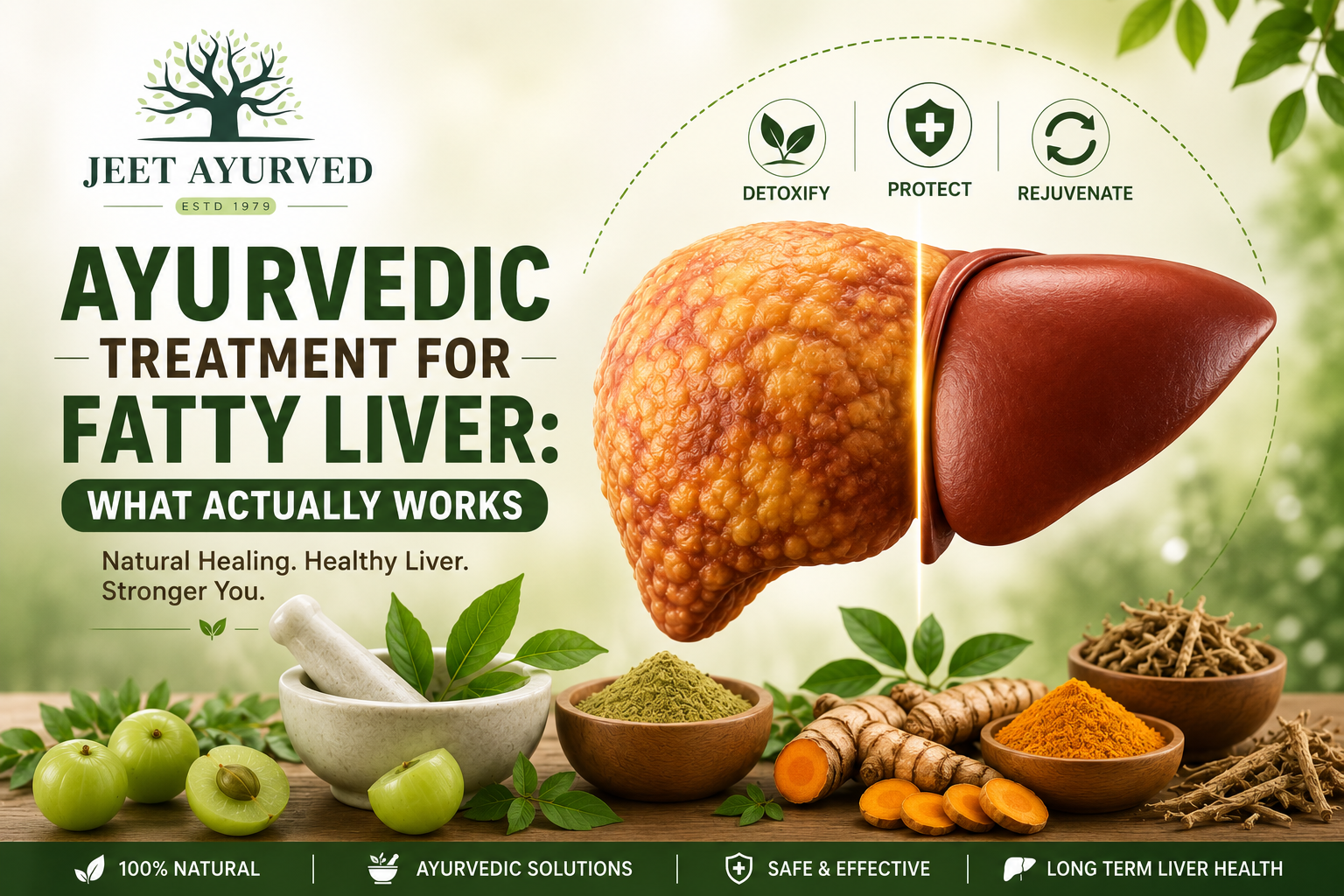
Fatty liver is one of the most common liver concerns today, quietly affecting people who feel otherwise fine. Ayurveda doesn’t treat it as an isolated liver problem — it looks at digestion, metabolism, and daily habits as a connected system, and works to bring that system back into balance. Below, we break down what Ayurveda actually says about fatty liver, which approaches have real substance behind them, and where Ayurveda’s limits are.
Fatty liver develops when excess fat builds up in liver cells faster than the liver can process it. It’s usually grouped into two types: non-alcoholic fatty liver (linked to diet, weight, and metabolic factors) and alcoholic fatty liver (linked to long-term alcohol use). In both cases, the liver’s ability to filter, process, and regulate the body starts to slow down.
Modern medicine typically identifies fatty liver through blood tests, ultrasounds, or enzyme levels, then recommends weight loss, dietary changes, and exercise as the core treatment. Ayurveda arrives at a similar destination — supporting the liver by addressing diet and lifestyle — but gets there through a different lens.
Classical Ayurvedic texts don’t use the term “fatty liver” directly, but the pattern is described under broader categories like Yakrit Roga (liver disorders) and Medoroga (fat-tissue imbalance). In Ayurvedic terms, fatty liver is closely tied to:
Put simply: Ayurveda sees fatty liver less as “a liver problem” and more as a downstream result of digestion that’s been out of balance for a while. That’s why Ayurvedic approaches focus heavily on restoring digestive fire, not just targeting the liver in isolation.
Fatty liver is often silent in its early stages, which is part of why it can go unnoticed for years. Ayurveda pays attention to a set of subtler, everyday signs that Western diagnostics don’t always connect to the liver directly:
None of these signs confirm fatty liver on their own — they’re not a substitute for an actual diagnosis — but Ayurveda treats them as early cues that digestion and liver function may need attention, well before a blood test would flag anything.
For more established cases, classical Ayurveda sometimes recommends Panchakarma — a set of supervised detoxification therapies. The most commonly referenced for liver support is Virechana, a therapeutic purgation method traditionally used to clear excess Pitta and Kapha and reduce the toxic buildup (Ama) linked to liver strain. Other therapies like Basti (medicated enemas) and Abhyanga (oil massage) are sometimes used alongside it to support circulation and metabolic balance.
It’s worth being direct about this part: Panchakarma therapies are intensive and are meant to be done under the guidance of a trained Ayurvedic practitioner, not attempted independently. They aren’t necessary for everyone — many people see meaningful support from consistent herbs, diet, and lifestyle changes alone, without needing to pursue Panchakarma at all.
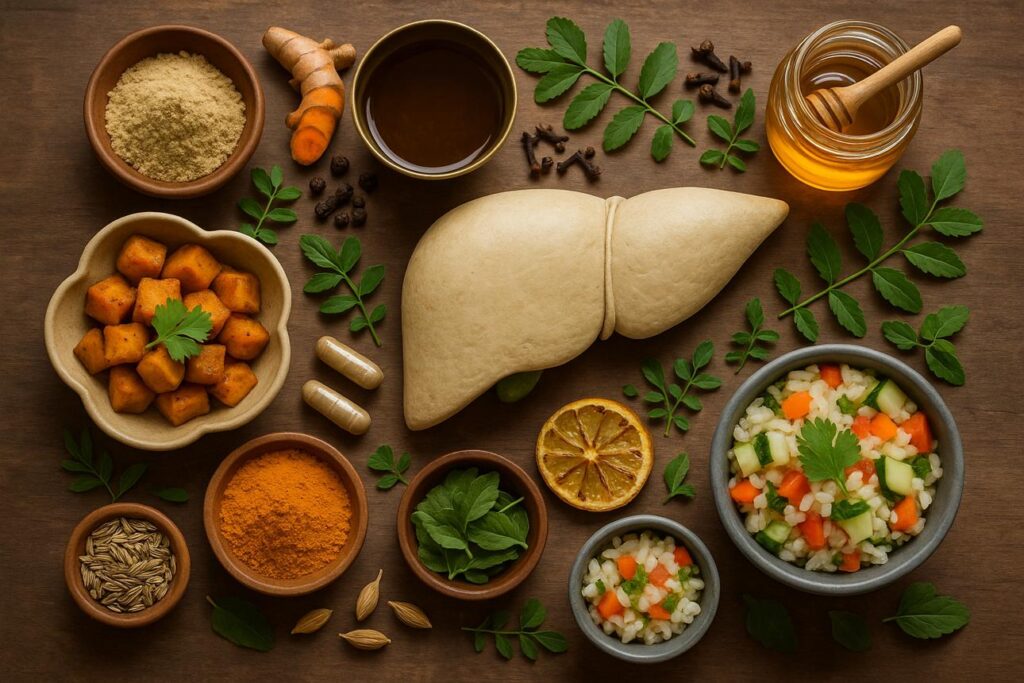
A number of herbs show up consistently across Ayurvedic liver formulations, each traditionally used for a specific role:
These herbs are typically combined rather than used in isolation, since Ayurveda treats fatty liver as a multi-system issue, not a single-target one.
This is the piece that gets overlooked the most, and it’s arguably the most important one. Ayurveda is clear that herbs alone rarely make a meaningful difference if digestion (Agni) stays weak and diet stays unchanged. A few core dietary principles show up across Ayurvedic liver guidance:
None of this is exotic advice — but it’s foundational. Ayurveda treats herbs as a support system that works with better digestion, not a substitute for it.
Along with diet, Ayurveda places real weight on daily movement and stress management as part of liver support:
It’s worth being clear-eyed here: Ayurveda is not a replacement for medical diagnosis or care, especially for advanced liver conditions. Herbs and lifestyle changes can meaningfully support early-to-moderate fatty liver concerns, but they work best as part of a broader plan that includes proper diagnosis, monitoring, and — where a doctor has identified something more advanced — appropriate medical care. If you have a diagnosed liver condition, are on medication, or are unsure about your liver health, talk to a healthcare provider before making major changes.
The Ayurvedic view of fatty liver isn’t a quick fix — it’s a combination of:
This is the same principle behind formulations like Liver Leaf, which combines several of the traditional liver-supportive herbs above into a single daily formulation, designed to support healthy fat metabolism, enzyme balance, and the liver’s natural detox process — alongside the dietary and lifestyle habits outlined here, not instead of them.
There’s no single herb or overnight fix that reverses fatty liver — and any approach claiming otherwise, Ayurvedic or not, is worth being skeptical of. What Ayurveda offers instead is a consistent, whole-system framework: strengthen digestion, reduce the daily load on the liver through diet, support the body with traditional herbs, and stay physically active. It’s a slower path than a quick promise, but it’s also one built on centuries of observation about how the body actually responds to sustained lifestyle change — which lines up with what modern research on fatty liver reversal shows too: gradual, consistent changes tend to outperform anything abrupt.
Can Ayurveda actually help with fatty liver?
Ayurveda offers herbs and lifestyle approaches traditionally used to support liver function, digestion, and healthy fat metabolism. Results vary by individual and by how consistently the approach — herbs, diet, and lifestyle together — is followed.
How long does it take to see results with Ayurvedic liver support?
Most traditional guidance points to gradual improvement over weeks to months, not days. Consistency with diet, herbs, and lifestyle matters more than any single remedy.
Do I need to change my diet if I take liver-supportive herbs?
Yes — Ayurveda treats herbs as one part of a broader approach. Diet and digestion are considered the foundation, and herbs work alongside them rather than replacing them.
Is Ayurvedic liver support safe to use long-term?
Traditional Ayurvedic herbs used for liver support, like the ones listed above, are generally used as part of ongoing wellness routines. As with any supplement, it’s worth checking with a healthcare provider if you have an existing condition or take medication.
What’s the first thing to change if I’m concerned about liver health?
Ayurveda points to digestion first — eating warmer, lighter, more consistent meals — before adding herbs or supplements on top.