
Joint pain doesn’t usually show up overnight. It tends to build gradually — a little stiffness after sitting too long, a knee that complains on stairs, a shoulder that never quite loosens up. Ayurveda has a specific way of explaining why this happens, and it’s more detailed than simply “wear and tear.” Here’s how Ayurveda understands joint pain, and what that explanation actually points toward.
Ayurveda doesn’t treat joint pain as one single condition — it distinguishes between two main patterns, each with a different underlying cause:
This distinction matters because Ayurveda’s recommended approach differs depending on which pattern is at play — a purely Vata-drying issue is treated differently than an Ama-driven inflammatory one, even though both can look similar on the surface.
Vata governs movement throughout the body, and joints — where movement literally happens — are considered one of its primary seats. When Vata is in balance, it supports smooth, lubricated movement. When it’s aggravated, its dry, light, and mobile qualities are believed to strip the natural lubrication from joint tissue, leading to the classic signs of stiffness, cracking, and degeneration over time.
A number of common habits are traditionally linked to aggravating Vata in the joints:
For the Amavata pattern specifically, Ayurveda traces the problem back to digestion. When Agni (digestive fire) is weak, food isn’t fully broken down, and the resulting Ama is believed to circulate through the body and settle in the joints, where it combines with aggravated Vata to cause inflammation, swelling, and pain.
This is why Ayurvedic approaches to inflammatory joint pain often start with digestive support — clearing Ama and strengthening Agni — rather than jumping straight to joint-specific treatments. It’s the same underlying logic that shows up across many Ayurvedic conditions: digestion sits at the root of far more than just stomach issues.
A handful of herbs appear consistently across Ayurvedic approaches to joint pain, chosen for different roles depending on the underlying pattern:
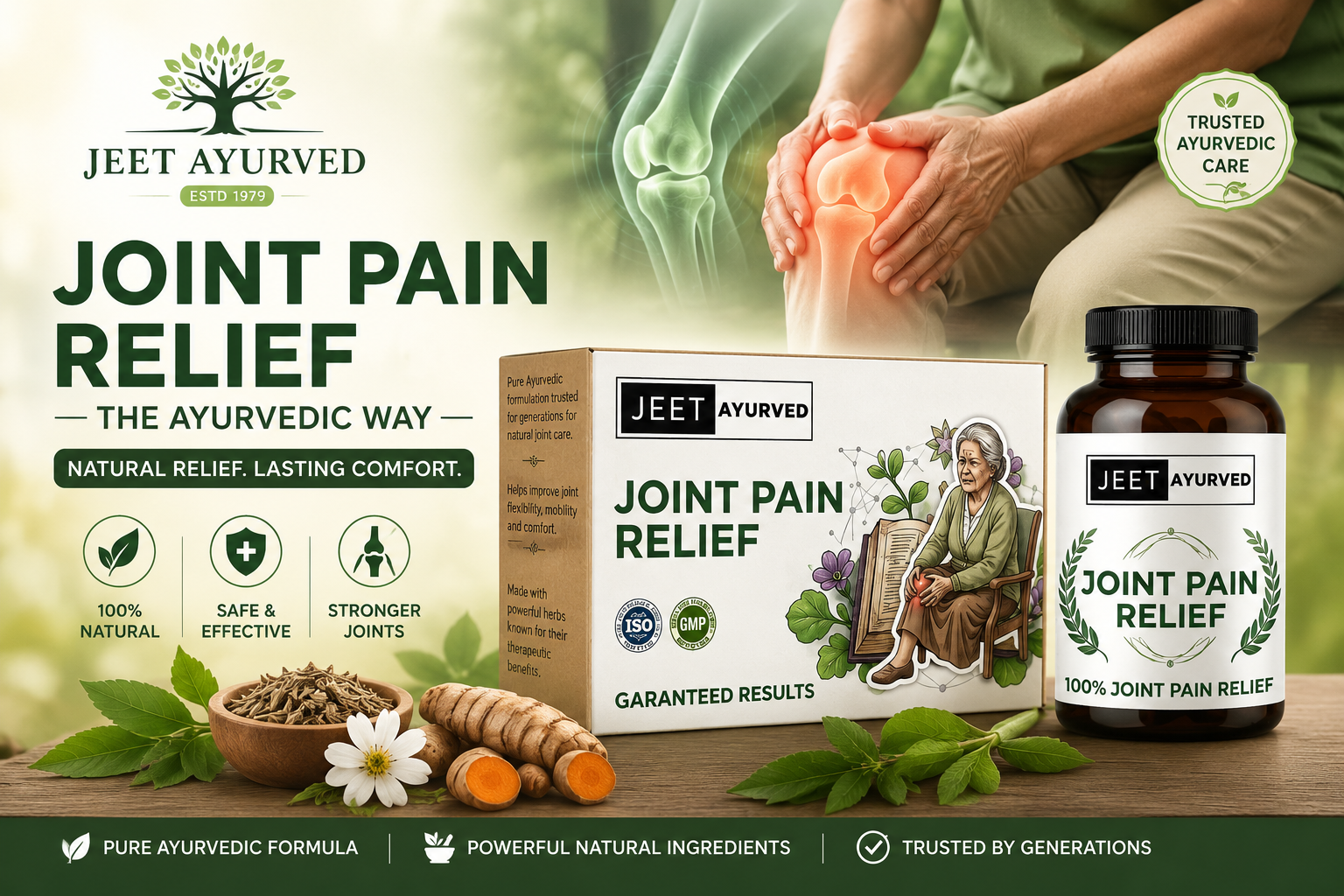
These herbs are typically combined into a single formulation rather than used individually, since Ayurveda treats joint health as connected to digestion and overall tissue nourishment, not an isolated local issue. This is the same principle behind formulations like Joint Pain Relief, which brings several of these traditional herbs together to support comfort and mobility as a whole system.
Beyond herbs taken internally, Ayurveda places real emphasis on external, warming therapies for joint health:
These practices are simple, low-cost, and traditionally recommended as a daily or near-daily habit, not an occasional treatment.
Movement is important for joint health, but Ayurveda is specific about the type: gentle, consistent movement rather than intense or high-impact activity, which can further aggravate an already Vata-dominant joint pattern.
For those balancing joint care with an active lifestyle, formulations like Athlete Power are built around supporting stamina and recovery for consistent, moderate movement, rather than pushing through overexertion.
Alongside herbs and external therapies, Ayurveda pays close attention to diet as a way to pacify Vata and reduce Ama:
None of this replaces herbs or external therapies, but it’s treated as foundational — the same way diet underlies Ayurveda’s approach to nearly every condition, from digestion to energy to joint comfort.
It’s worth pausing on this, since joint pain is an area where a lot of confident claims get made without much backing them up. According to NCCIH’s fact sheet on turmeric, part of the U.S. National Institutes of Health, several studies have found turmeric or curcumin may have a positive effect on osteoarthritis pain and stiffness, but the evidence is still described as preliminary, and higher-quality research is needed for firm conclusions. NCCIH also notes that some highly concentrated curcumin formulations have been linked to liver injury in rare cases — a reminder that “natural” doesn’t automatically mean risk-free, and that quality and dosing matter.
This doesn’t mean turmeric or other traditional joint herbs aren’t worth using — it means treating them as a genuine, evidence-informed support, not a guaranteed fix, and checking with a healthcare provider if you’re on medication or have an existing liver or health condition.
Most mild, gradual joint stiffness responds reasonably well to the approaches above over several weeks. But sudden, severe joint pain, significant swelling, redness, fever, or pain following an injury are signals to see a doctor rather than relying on herbs and warm oil alone. Some inflammatory joint conditions need proper medical diagnosis and management, and Ayurvedic support works best alongside that care, not instead of it.
A realistic Ayurvedic approach to joint pain includes:
If you’re looking to build a joint-care routine around these principles, you can explore our full range of Ayurvedic remedies to find formulations that support comfort and mobility as part of a consistent daily approach.
What does Ayurveda say causes joint pain?
Ayurveda attributes most joint pain to aggravated Vata dosha, sometimes combined with Ama (toxic buildup from poor digestion), leading to dryness, stiffness, or inflammation depending on the specific pattern.
What’s the difference between Sandhivata and Amavata?
Sandhivata is a Vata-driven, degenerative pattern similar to osteoarthritis, typically worsening with movement. Amavata involves Ama combining with Vata, causing more inflammatory symptoms like swelling and morning stiffness, similar to rheumatoid arthritis.
Does turmeric actually help with joint pain?
Some studies suggest turmeric or curcumin may help with osteoarthritis pain and stiffness, though NCCIH describes the evidence as still preliminary. It’s reasonable to try as part of a broader approach, with realistic expectations.
Is warm oil massage actually helpful for joint stiffness?
Ayurveda considers it a core practice for Vata-type joint issues, traditionally used to improve circulation and counter dryness. It’s low-risk and widely used as a regular habit rather than an occasional treatment.
When should joint pain be seen by a doctor instead of managed at home?
Sudden, severe pain, significant swelling, redness, fever, or pain following an injury should be evaluated by a doctor rather than managed solely with home remedies.




Welcome Back 👋
Sign in to access your account and continue where you left off.
Welcome Jeet Ayurved🚀
Create your account to access everything you need.